How I learned to love personal development
Our daily grind has a tendency to push personal development in shadows of delivery and deadlines. Personal development, something that needs constant fostering often attracts muted attention and gets precipitous intervention when “people-team” reminds us about the half yearly review cycle. Even after spending a decade in my profession, I find myself often disoriented and confused about how I am tracking my progress against the goals that I have; and that is, if I have charted out my goals at all. In recent past, I have made a renewed effort to find structure in my personal development and reorganize it in ways to make it easier to tackle and track both. While I am still on a journey to realize its effectiveness, I hope to share my thought process and the technique both in a hope that you find it relevant and useful too.
The road ahead
For me introspection is crucial part of personal development. It is important for me to know and have an opinion about how my career is going. However at the same time I find the thought process overwhelming. I typically attack it by building a list of role models and find a persona that resonates with me most. Using that persona coupled with my interests, I try to chart a long term goal that leads me in that direction. It is worth noting that personas merely act as a guide to chart my long term career path and high level skill categorization. I would eschew from imitating the exact skills since the individual strengths can vary significantly. To elaborate on this, I have few fictional personas listed below; let me pick one and walk through the process.
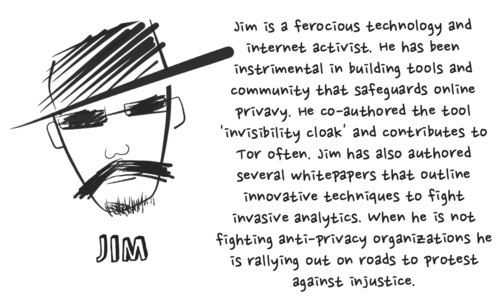
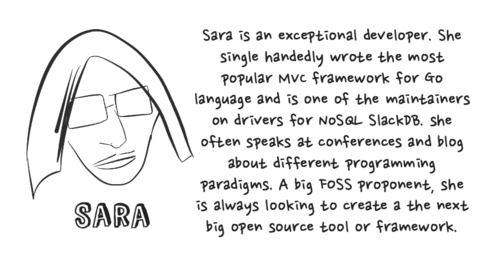
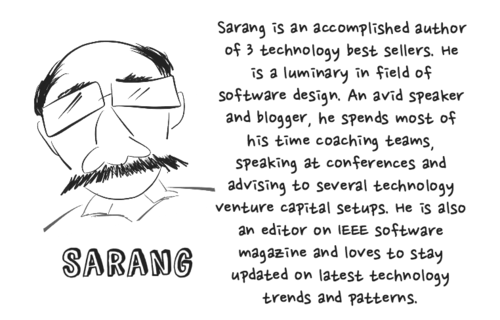
I would say that I resonate with Sara most and I have a strong belief that mobile and internet of things will converge eventually. I also think there is a huge potential to simplify the bridging between both. Coupling them together, a reasonable goal for me for next 18-24 months could be “I want to establish and associate myself to mobile and Internet of things domain. I intend to contribute by building an ecosystem & community that simplifies and makes cross platform development for mobile & other devices effective.”
A high level goal is great however it needs to be broken down into short term actionable items. This step requires me to build structure in which I would collect feedback, collate data and measure. At this point I would have given enough thought to my goal and would have a sense about the most crucial skills that I need to acquire? I tend to classify similar skills together and pull them in a category. Although I know people who approach this other way round. They look at generic categories and identifying things they would like to focus on under each of them. An example output of this categorization for me would involve categorizing activities like blogging, conferences, FOSS etc together in “community contribution”; while each of those would become axes I measure myself on. Lets look at this in bit more of detail.
Pivoting on spider charts
Once I have taken a look at my long term goal, it is probably wise to take a stock of where I am currently. This will help me identify areas that need most work and actionable items that will help me reach there. There are two ways I gather this data. Feedback is a great way to start, but I usually find it more useful if I distill down my thoughts first into spider chart visualizations asking myself “How did last 6 months go for me”. It helps me build a sense of things and rate myself on different axes. Once I have that data ready, I reach out for feedback and compare the perception of people around me, on those axes to the data I have from my intuition. It helps me spot outliers and identify false notions both.
Coming back to spider charts, I define them with identified categorizations, axes and levels. I would typically identify root categorization like Technology, Community contribution, Soft skills and Consulting. Each of these categories have a spider chart of their own with sub categories as axes and each axis has typically three rating levels. These levels are very personalized and the lowest bar is in context of my experience with that categorization and an assumption that I have room to improve.
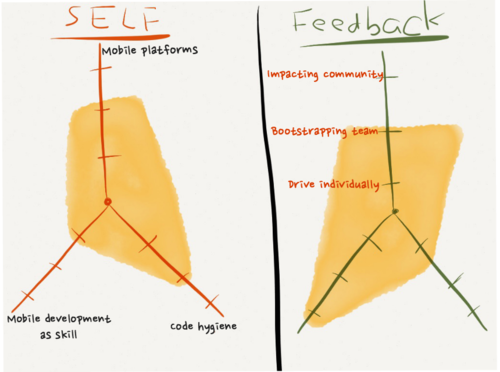
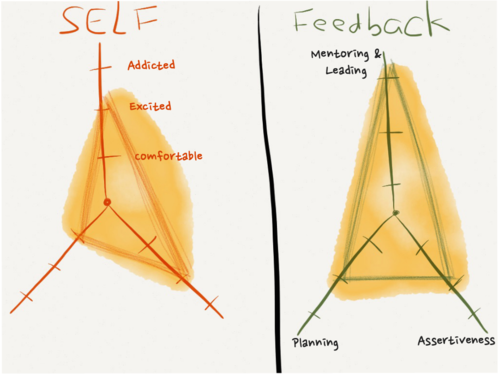
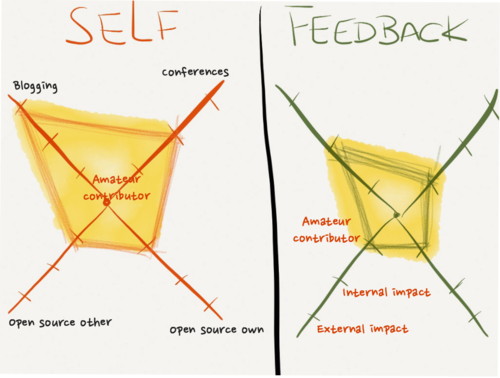
Take a cursory look at the charts, categorization, sub categorization and ratings below to get a sense of data I have at this point. The charts on left are based on “how I feel” about capabilities and skills and the ones on right are based on “feedback from team”. Each axis represent a single subcategorization listed in “axes” column and three levels of ratings are defined by “rating levels” column.
Technology
Axes
- Mobile platforms - How many of them do I understand?
- Mobile development as a skill - How well do I understand mobile?
- Code Hygiene - How well can I write code?
Rating Levels
- Drive individually
- Bootstrapping a team and running with it
- Impacting community
Community contribution
Axes
- Blogging
- Speaking
- Open source contribution to existing frameworks
- Open source frameworks used by at least 5 people/teams
Rating Levels
- Amateur contributor
- Internal impact
- External impact
Soft skills
Axes
- Mentoring & Leading
- Assertiveness - Based on feedback in past. (Am I assertive when needed?)
- Planning - Based on suggestion in past (Do I proactively plan on behalf of team?)
Rating Levels
- Comfortable
- Excited
- Addicted
As you can see, these charts are often a great reality check tool apart from presenting relevant data visually. In soft skills section, rating levels are more generic and rational for different sub categorization is bit more pragmatic. Some I want to proactively track, for others past feedback/suggestions is a motivation. This is to highlight, that intuition and feedback both should help build up axes of a categorization. I have covered only few categorizations here, however in reality, I would keep a few more. Some of those would include additional bits, like what have I done to improve efficiency, quality and innovation of our team as collective.
Introspection to action
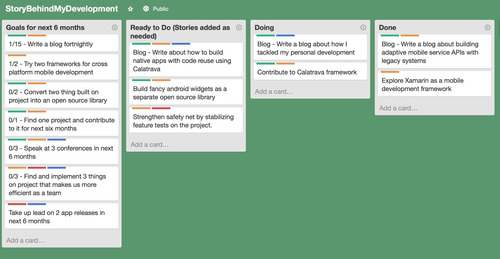
Once I have looked at visualizations and identified feedback and data against each category/axis I tend to define broad action items as stories on a wall. After all we are agile and feedback driven in daily delivery why should it be any different when it comes to our own development? However discipline to strike through the items is also the hardest part for the next six months. (Six months is a period I feel comfortable with to revisit my progress and up-skilling). The obvious mistake that I have done in past is bog myself down with tons of action items or make action items too beefy resulting in constant procrastination. So this time around I am experimenting with two key differences.
- I have limited the number of goals for next 6 months between 6-8. These can be further broken down into small tasks though.
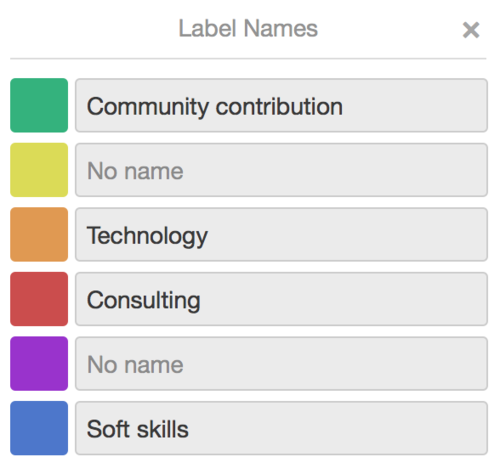
- I track my progress using a combination of virtual wall and labeled classification to keep a check on balance I strike between different categorization.
You can see the goals, task list and labels in the images below. Feel free to check out the wall here on Trello. The wall is public but it may not show you label classification in read only mode.
Periodic checkpoint and follow through
I find a periodic catch up with select few to be a good motivator to stay on track, so I have set a 5 minute recurring google calendar invite with few people to review my Trello board every 30 days for next 6 months. That reminds everyone periodically about taking out a minute to review progress and also helps me stay focused on tasks to prepare for next catch up.
Aspirations and support
Individuals often need to invest time on team to build better software, it is equally important that teams take time to allow individuals to focus on personal development. Therefore, accommodating a personal development story card for an individual in iteration planning is an excellent way to allocate time for individual development and reap benefits as a team. This approach can be powerful as it often help tackle tasks that require either experimentation, a chunk of continuous time or resources/complexity that only project can offer.
Beyond that I typically identify any aspiration or support that I need from organization. Letting those know up front helps tap opportunities better and allow for a better planning for individual development as well. This is very organization specific, however in my current organization, this support in terms of resources and time both, is easy to find. So there isn’t a lot I need to do about this as long as I know what I want and how it helps.
The final word
All of that being said it is probably prudent to accept that, no matter how many failsafe mechanism I put to refrain myself from being distracted or straying away into an ad-hoc approach; nothing trumps focus and discipline. I do not see this approach as a substitute for that, it is merely a structure that forces me to give personal development enough thought and augments to it by helping me define tasks that are easier to follow through, range across skill sets and require smaller/gradual time commitment.
I hope, you find at least few things that are interesting to you. I would love to hear about, how you attack your personal development and things that work for you or don’t.